


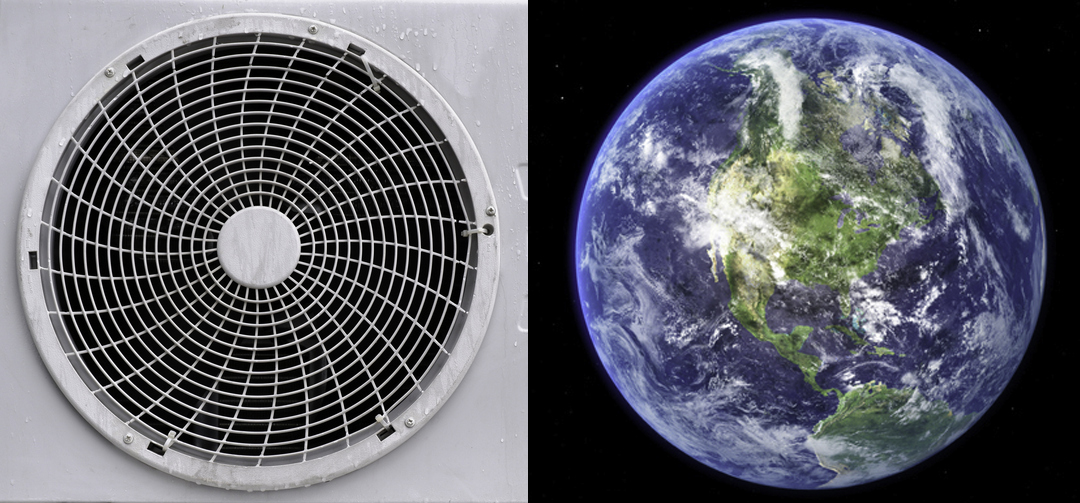
Here at Maertin Heating & Cooling, we know our customers are concerned about our environment, sustainability and safety – along with the need to stay cool in the hot weather!
Experts estimate that refrigeration and air conditioning account for 20% of global energy consumption. As both our environment and technologies get hotter, the demand for cooling is increasing. Fortunately, ever since inventors began harnessing the thermodynamic properties of chemical refrigerants nearly two centuries ago, cooling technologies have continued to advance. Unfortunately, many refrigerants have turned out to be toxic for people and the planet. However, as scientists and researchers have discovered the harm past refrigerants caused, they have worked to develop safer, less toxic options to keep us comfortable and the environment intact.
HVAC researchers have discovered much about the toxic dangers of refrigerants because early refrigeration and cooling standards followed a “whatever works” model of experimentation. Some of those chemicals, like ammonia, are still in use today in industrial uses, but were discontinued because they smelled, and early compressor technology tended to leak, releasing toxic ammonia into the air. One solution to the toxic, smelly refrigerant problem was propane, which was odorless but also highly flammable. An alternative to both smelly ammonia or flammable propane was sulfur dioxide, which was both smelly and dangerously toxic to humans.
Refrigerant and cooling companies began experimenting and even designing new chemical refrigerants in the early 20th century to overcome what initially were seen as household air-quality issues. Notably, refrigeration came to rely on a series of chemical known as chlorofluorocarbons or CFCs. The CFCs reduced both the toxicity and the flammability risk compared to other early refrigerant options. While CFCs proved safer for home cooling, scientists then discovered that CFCs collected in the upper stratosphere, where the sunlight causes the chemical to breakdown and produce chlorine. The chlorine was eroding the ozone layer, which absorbs UV radiation that causes skin cancer, cataracts and damage to plants and animals.
To combat the eroding ozone layer, we needed a new range of refrigerants. Industries and governments began looking for a new definition of “what works” for refrigeration that included limiting atmospheric damage and climate impacts. As a result, CFCs were largely phased out as a result of changes in both policy and chemistry in the early 1980s.
Building on discoveries in the shift from CFCs to Hydrofluorocarbons (HFCs), now scientists have produced safer and more efficient refrigerants.
In an effort to combat the climate effects of all this cooling, a new set of refrigerant guidelines recently were enacted. These may require changes the next time your Maertin HVAC technician needs to top off or recharge your system. The chemical make-up of refrigerants require chemically precise materials in your air conditioner compressor, condenser, and evaporator. Some, but not all, new formulations can be dropped into existing systems. Some systems can be retrofitted. In some cases, replacing the system may be a more cost-effective solution.
Scientists unfortunately believe they may have reached the end of the molecular trail for new refrigerants based on existing science and technology. However, the hydrofluorocarbon (HFC) refrigerants they have identified have allowed the ozone layer to replenish itself. And somewhere, an as-yet-unknown scientist or chemist may be blazing an entirely new sustainable trail to help keep our homes cool and reverse the effects of climate change!
Do you have questions? Call us at 708-479-9350 or talk to your Maertin HVAC technician at your next maintenance check to understand how new refrigerants and guidelines may impact your cooling system.